
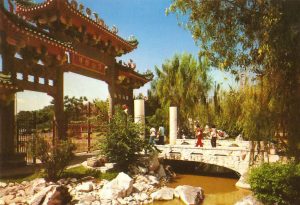
Shuang Lin Garden in the 1970s
In 1971, the Singapore Tourism Board (STB) proceeded with the plan of the Suhang Garden, which proposed to classify Shuang Lin Monastery as a tourist attraction. This culminated in the construction of a lake, a stone bridge and a stone mountain in front of the Hall of the Celestial Kings, with the area being named as Shuang Lin Garden. It was only then that the task of building the pagoda was stopped. In early 1972, Venerable Long Gen concluded his three-year retreat, for which a welcome ceremony was held. In the middle of 1972, the Symposium on the Design and Construction of Shuang Lin Monastery was held in which individuals from the arts and cultural sectors were invited to participate.
In 1974, STB launched the opening ceremony of Shuang Lin Garden.
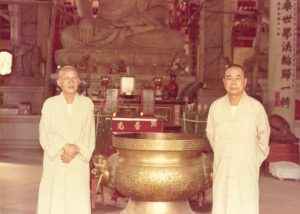
Venerable Cheng Xiong (left) and Venerable Tham Sean (right)
In 1975, Master Tham Sean took over as the 13th abbot. Master Xiong He, abbot of the Medan Temple in Indonesia (who is also one of the members of the board of trustees of Shuang Lin Monastery), feared for the collapse of the halls when he saw the shedding of the roof tiles in the Dharma hall. Hoping to restore the Dharma hall to its original style to allow the flourishing of Buddhism, he made a generous offer to sponsor the costs of rebuilding the Dharma hall as well as the underground ordinary tower. It was a pity that at that point in time the craftsmen from Fujian, China, were not available for hire. Given the consideration of the safety issue, the task of rebuilding was not to be delayed. In the end, they decided to assign the task of rebuilding the Dharma hall to the local construction contractors with Master Tham Sean overseeing the project, while at the same time maintaining the drum tower. In 1980, the Preservation of Monuments Board announced Shuang Lin Monastery as the 19th national monument, making it the only Buddhist monastery to be given the status of a national monument.